
I have many of my own poems memorized — not on purpose, they just automatically get imprinted from revising them so much. I don’t have anybody else’s poems memorized, except for a few favorite lines here and there (“Do not confuse size with scale: / the cathedral may be very small, / the eyelash monumental,” by Dean Young, for example). I wish I remembered poems the way I remember random songs from like 2005, but alas, that’s not how my brain works, so I know the lyrics to Ocean Avenue, even though I haven’t listened to that song in probably a decade, yet I can’t recite a single Mary Ruefle poem, even though I love her.
My favorite formal constraint is probably just writing a poem that’s visually pleasing to me. I certainly don’t go as far as somebody like CAConrad when it comes to being almost a visual artist using text (I love their shapes), but I do feel like certain shapes fit certain poems, and I try to honor that fit. Some poems are jagged, some are smooth, some are blocklike, some are like sideways mountain ranges, some are like long skinny rows of ants, some are divided up into couplets, etc. For me, determining the shape of a poem is an intuitive process, one that’s related to the voice and sound of the poem, and at a certain point while writing it begins to guide the language, and that’s about as close as I get to formal constraint.
I’m a simple creature, a creature of the now — contemporary poetry is my favorite. I’m glad I was born when I was, poetrywise, and I think the next twenty years are going to be full of incredible poets I haven’t even heard of yet.
I’ll listen to almost anything while I’m writing as long as there are no words in it, because words tend to distract me. My current favorite writing songs are kyema, by Éliane Radigue, and Spiegel im Spiegel, by Arvo Part.
Writing is deeply personal, but submitting your writing for publication, for the most part, is not. When you submit your poems, they join a huge pile of other poems by other people. Whether or not your poem makes it out of that pile probably depends more on the editor’s current mood than it does on the quality of your poem. So accept the fact that you are going to get rejected — a lot — and try not to take it personally. Be proud when you get rejected, because it means you are putting yourself out there. Just keep writing, submitting, and waiting curiously for the right people to encounter your poems at the right moments in order to say yes.
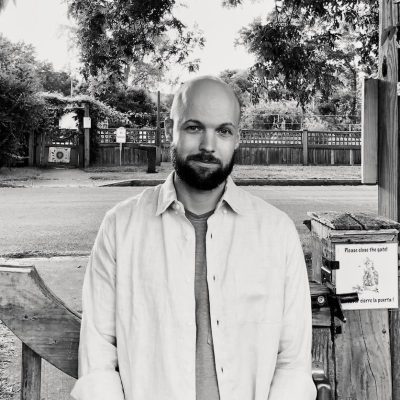
Mikko Harvey is the author of Let the World Have You (House of Anansi, 2022) and Unstable Neighbourhood Rabbit (House of Anansi, 2018). He lives in Northampton, Massachusetts.